
Before You Begin
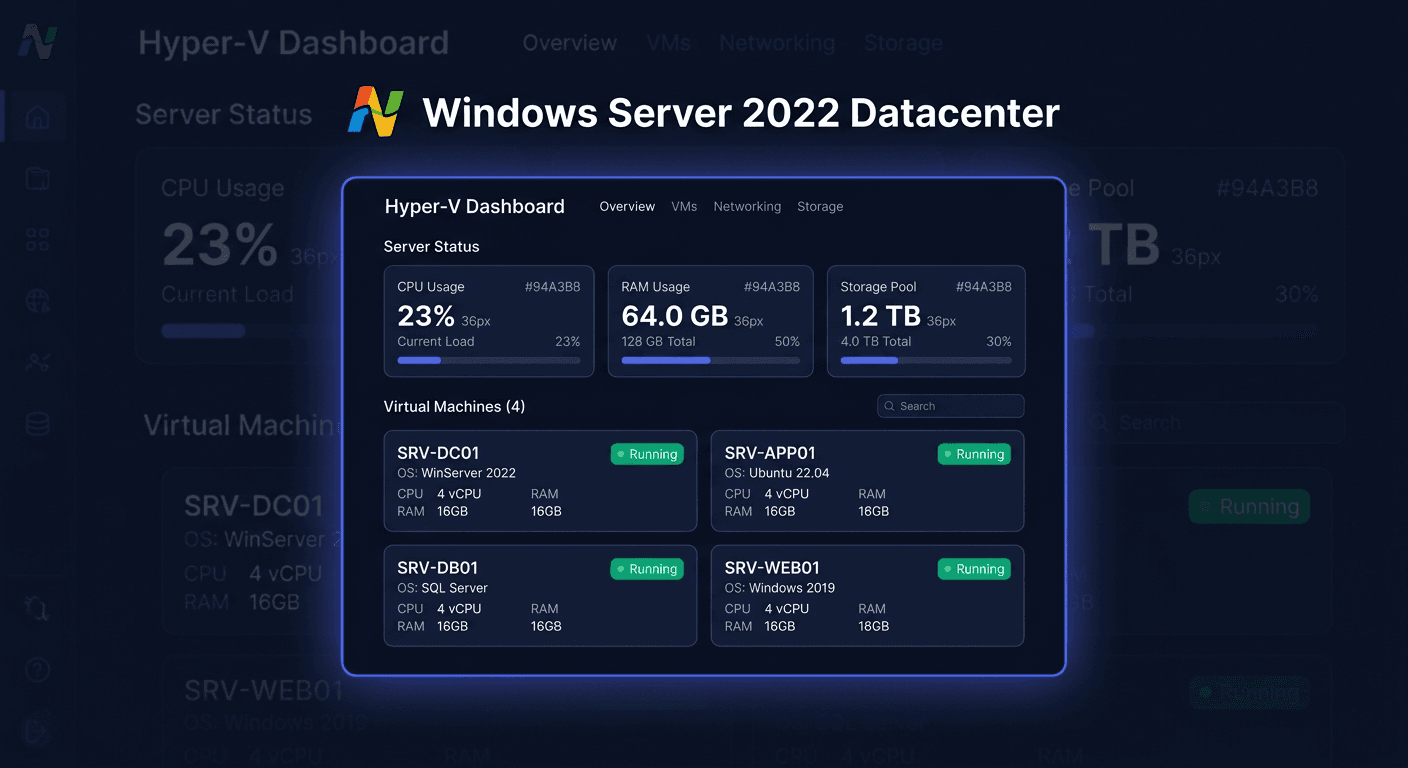
Microsoft Windows Server 2022 is the latest version of Microsoft's server operating system, designed to support modern IT environments, including on-premises, cloud, and hybrid infrastructure. KluczeSoft offers legal licenses for Windows Server 2022 along with Client Access License (CAL) packages, which enable users or devices to access server services.
In this article, we focus on the Windows Server 2022 50 User CAL license, which allows access to server services for 50 users. User CAL is an ideal solution for companies where employees use multiple devices, as it licenses the user, not the hardware.
What Does KluczeSoft Provide?
- Original Windows Server 2022 50 User CAL license key
- VAT invoice and license legitimacy confirmation
- Technical support for installation and activation
- Access to the customer panel with instructions and downloadable files
Technical Support Terms
| Version | Release Date | End of Mainstream Support | End of Extended Support |
|---|---|---|---|
| Windows Server 2022 | 18.08.2021 | 13.10.2026 | 14.10.2031 |
After the end of extended support, the system will no longer receive security updates, which may expose the company to risk. We recommend planning updates before this date.
Important: CALs are version-specific – User CAL for Windows Server 2022 allows access to this version and earlier ones, but not to newer ones.
System Requirements
Before installation, ensure that your hardware meets the minimum system requirements in accordance with Microsoft documentation:
| Component | Minimum Requirements |
|---|---|
| Processor | 1.4 GHz 64-bit processor compatible with x64 architecture |
| RAM | 2 GB (Server Core installation) / 512 MB (Server with Desktop Experience installation) |
| Disk Space | 32 GB (more recommended for GUI or update installations) |
| Network Card | Compatible with PCI Express, supporting PXE boot |
| Graphics | Super VGA (1024x768) or higher |
| Input Devices | Keyboard and mouse, monitor |
| Other | DVD drive (if installing from media), internet connection |
Note: In practice, for production environments, higher parameters are recommended, especially more RAM and a faster SSD disk.
Step 1: Preparing for Installation
Before starting the installation:
- Verify that you have the Windows Server 2022 installation media (ISO or DVD).
- Prepare the product key and CAL license file (if required).
- Back up important data.
- Ensure you have access to an administrator account.
Step 2: Installing Windows Server 2022 – Step by Step
1. Running the Installer
- Insert the installation media (DVD/USB) or mount the ISO file.
- Start the server and set it to boot from the appropriate media (BIOS/UEFI).
- After loading the installer, the "Windows Setup" screen will appear.
2. Selecting Language and Regional Settings
- Select the installation language, time format, and currency, as well as the keyboard layout (e.g., Polish).
- Click "Next".
3. Starting the Installation
- Click "Install Now".
4. Entering the Product Key
- Enter the Windows Server 2022 product key (if required at this stage).
- Click "Next".
5. Selecting the System Edition
- Choose the appropriate edition (e.g., Standard or Datacenter, with GUI or Server Core).
- Click "Next".
6. Accepting the License Terms
- Read and accept the license terms.
- Click "Next".
7. Selecting the Installation Type
- Choose "Custom: Install Windows only (advanced)".
8. Selecting the Target Partition
- Indicate the disk/partition where the system will be installed.
- Click "Next".
9. Installing System Files
- The installer will copy files and perform the installation (this may take several minutes).
10. Initial Configuration
- After restarting, set the password for the administrator account.
- Log in to the system.
Tip: If you are installing the Server Core version, configuration is done through the command line.
Step 3: Activating with a Product Key
Method 1: Activation via GUI
- Open "Settings" → "Update & Security" → "Activation".
- Click "Change product key".
- Enter the received Windows Server 2022 product key.
- Click "Next" and follow the instructions.
Method 2: Activation via Command Line
- Open "Command Prompt" as an administrator (Start → type "cmd" → right-click → "Run as administrator").
- Enter the following commands:
cd %windir%\system32
slmgr.vbs /ipk XXXXX-XXXXX-XXXXX-XXXXX-XXXXX
slmgr.vbs /ato
Replace XXXXX-XXXXX-XXXXX-XXXXX-XXXXX with your product key.
Activating CAL (User CAL)
User CAL does not require installation on the server – licenses should be stored and recorded in accordance with Microsoft policy. For services such as Remote Desktop Services (RDS), CAL installation and activation are done through the Remote Desktop Licensing Manager.
Installing RDS CAL (if applicable)
- Open "Server Manager" → "Manage" → "Add Roles and Features".
- Add the "Remote Desktop Services" role and configure the "Licensing Manager".
- In the Licensing Manager, right-click the server name → "Activate Server".
- After activation, select "Install Licenses" and enter the CAL key.
Step 4: Verifying Activation
Checking System Activation
- Open "Command Prompt" as an administrator.
- Type:
cd %windir%\system32
slmgr.vbs /xpr
Information about the activation status will be displayed.
Checking RDS License Status (if applicable)
- Open "Remote Desktop Licensing Manager".
- Check the number of installed and available CALs.
If you need help with the activation process or have any questions, please contact us at [email protected] or call 00 800 121 1654.
Step 5: Post-Installation Configuration
After installing and activating the system, perform the following basic configuration tasks:
- Change the server name – in "Server Manager" → "System Properties" → "Change settings" → "Change".
- Join the domain – if you are using Active Directory, join the server to the company domain.
- Install updates – run "Windows Update" and install all available fixes.
- Configure the firewall and server roles – e.g., DNS, DHCP, files, Hyper-V.
- Create user accounts – through "Active Directory Users and Computers" or locally.
- Configure backups – use "Windows Server Backup" or another tool.
Tip: Regularly create backups and test data recovery procedures.
Step 6: Troubleshooting
Below, we present common problems and their solutions:
1. Activation error 0xC004F074
Description: The system cannot contact the KMS activation server. Solution:
- Ensure you have an internet connection.
- If using MAK activation, use the command
slmgr.vbs /ato. - Check proxy/firewall settings.
2. "Product key is invalid" error
Description: The entered key is not accepted. Solution:
- Verify that you are entering the key without typos.
- Ensure the key is for Windows Server 2022.
- Contact KluczeSoft to verify the key.
3. Unable to install CAL in RDS License Manager
Description: The CAL installation option is greyed out or inactive. Solution:
- Ensure the license server has been activated.
- Restart the "Remote Desktop Services Licensing" service.
- Check administrator account permissions.
4. Domain joining issue
Description: "Domain not found" error. Solution:
- Check DNS settings.
- Ensure the server has a connection to the domain controller.
- Verify that the system clock is synchronised.
5. System does not see all installed CAL
Description: After installing CAL in License Manager, they are not visible. Solution:
- Refresh the view in License Manager.
- Check if you are using the correct type of CAL (User/Device).
- Contact KluczeSoft technical support.
6. Error 0x8007007B during activation
Description: Error related to incorrect domain name or key. Solution:
- Check if the entered key is correct.
- Use the command
slmgr.vbs /ipkand reactivate the system.
Step 7: Comparing Versions and Prices at KluczeSoft
| Product | Number of CAL | Price (zł) | Support until |
|---|---|---|---|
| Windows Server 2022 50 User | 50 | 1399 | 14.10.2031 |
| Windows Server 2019 50 User | 50 | 1149 | 09.01.2029 |
| Windows Server 2025 1 User | 1 | 169 | 14.10.2036 |
More information and purchases: /windows-server-cals
Tip: The choice of version depends on the company's needs and planned technical support duration.
If you need help or have questions, please contact us at [email protected] or call 00 800 121 1654.
Summary
Installing and activating Windows Server 2022 with 50 User CAL requires knowledge of licensing rules and careful adherence to installation steps. With this guide, you can complete the entire process on your own, verify activation, and resolve the most common issues.
If you have any questions or problems, please contact our technical support team at 00 800 121 1654 or via the contact form on the KluczeSoft website.
Remember to regularly update your system and plan migration before the end of technical support.
Learn more about other licenses and server solutions in the category: /windows-server-cals